layout: post title: Cutting author: mo
Nutrition is vital to the development of strength.
You need to eat big, to get big!
The above guidace of is a lot of fun to say, but what does it really mean? Is it good guidance?
From July. 2016, - January. 2017 I followed the above guidance without much thought. This did lead to some great gains in strength but it did come at a cost.
The Data
Let’s analyze what happened. On July 19, 2016. I had a body composition test completed using a BodPod at 2110 Fitness, and then another on January. 21, 2017.
|—————–+————+—————–+—————-+—–|
| Date | Body Mass (lb) | Fat Mass (lb) | Fat Free Mass (lb) | % Fat | % Fat Free Mass | RMR |
|---|---|---|---|---|---|---|
| Jul 19, 2016 | 222.80 | 74.80 | 148.00 | 33.6 | 66.4 | 1820 |
| Jan 21, 2017 | 230.10 | 82.70 | 147.40 | 35.9 | 64.1 | 1814 |
| =================+============+=================+================+=====+=====+===== | ||||||
| ~6 months | +7.3 | +7.9 | -0.6 | +2.3 | -0.3 | -6 |
| —————–+————+—————–+—————- |
Let’s take a look at how my lifts progressed during the same time.
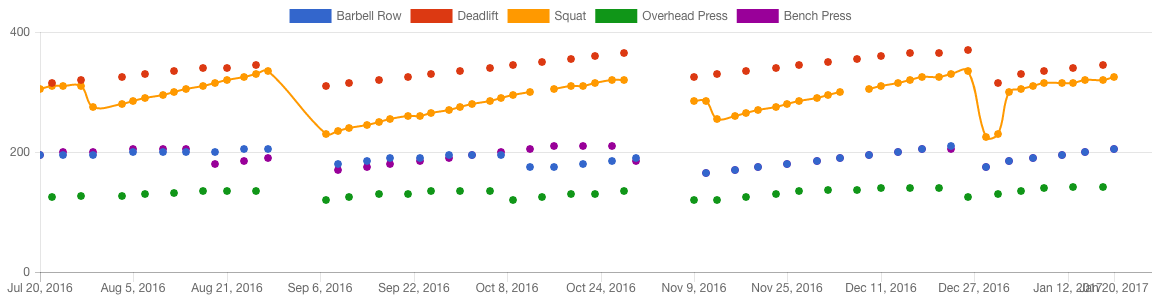
During this team it felt like I was making some incredible gains. So I
kept eating more.
Personal Records:
|—–+——+—–| | Date | Squat 3x5 | Bench Press 5x5 | Deadlift 1x5 | |—–+——+—–+—-| | July. 20, 2016 | | 195 lb | | July. 22, 2016 | | | 315 lb | | July. 27, 2016 | | | 320 lb | | July. 29, 2016 | | 200 lb | | August. 3, 2016 | | | 325 lb | | August. 7, 2016 | | | 330 lb | | August. 12, 2016 | | | 335 lb | | August. 17, 2016 | | | 340 lb | | August. 21, 2016 | 320 lb | | | | August. 24, 2016 | 325 lb | | | | August. 26, 2016 | 330 lb | | 345 lb | | August. 28, 2016 | 335 lb | | | | October. 12, 2016 | | 205 lb | | | October. 14, 2016 | | | 350 lb | | October. 19, 2016 | | | 355 lb | | October. 23, 2016 | | | 360 lb | | October. 28, 2016 | | | 365 lb | | December. 26, 2016 | 335 lb (tie) | | 370 lb | | January. 20, 2017 | | 205 lb (tie) | | |—–+——+—–+—-|
In summary, during the last 6 months of 2016, I increased my body fat
from 74.8 lb to 82.7 lb. My lean body mass decreased from 148.00 lb to
147.40 lb. Which translates to adding 8 lb of fat and losing about
0.5 lb of lean mass. I was shocked, because during this time it appeared
that I was getting stronger. Therefore, I must have been putting on more
muscle. This was a shocking awakening.
I experienced my first
Dirty Bulk.
If we look closer, I began to stall out on the Bench Press and Squat quite early on and these should have been indicators that something was off.
The Learning
Once I became aware of my poor progress I decided to learn more about nutrition.
I read Better Than Steroids and Bigger, Leaner, Stronger and I downloaded the MyFitnessPal app. Both books were good sources of information. Here’s what I learned from each.
Better Than Steroids
Total Daily Energy Expenditure (TDEE)
- (BMR) Basal Metabolic Rate: This is the minimum energy required by your body to survive.
- (TEF) Thermic effect of food intake: Enery spent on digestion, absorbtion and storage of foods.
- (TEE) Thermic cost of exercise: Energy spent during daily activities.
To determine how many calories you want to target per day you need to take the above factors into account.
The Harris-Benedict equation can be used to compute the BMR.
- Male: 66.5 + (13.75 x W) + (5.003 x H) - (6.775 x A)
- Female: 655 + (9.563 x W) + (1.850 x H) - (4.676 x A)
W = body weight in kilograms. H = height in centimetres. A = age in years.
Bigger, Leaner, Stronger
Katch McArdle equation to compute BMR.
- LBM = Lean body mass in kilograms.
- BMR = 370 + (21.6 * LBM)
TDEE
|—–+——| | Hours of exercise per week | TDEE Formula | |—–+——| | 1 - 3 hours | BMR * 1.2 | | 4 - 6 hours | BMR * 1.35 | | 6+ hours | BMR * 1.5 | |—–+——|
|—–+——| | Nutrient (1 gram) | Calories | |—–+——| | Protein | 4 | | Carbohydrate | 4 | | Fat | 9 | |—–+——|
Protein
A high-protein diet is absolutely vital for building muscle and preserving it when you’re dieting for fat loss. A low-protein diet is absolutely good for nothing. End of story.
Your body breaks down protein into amino acids. Amino acids are used to build muscle tissue. General guidance suggests 1 gram of protein per pound of body weight per day, and 1.2 - 1.5 grams per pound of body weight per day for those who are trying to lose fat.
Carbohydrate
There are 3 forms:
- monosaccharides: also known as simple carbs. (glucose, fructose, galactose)
- oligosaccharides: molecules that contain several monoscaccharides linkedto together.
- polysaccharides: long chains of monosaccharides.
They all end up as glucose. The longer the chain, the longer it takes to break down. Therefore, spending more energy to produce glucose. A chocolate bar can be converted to glucose faster than a bowl of peas.
Carbohydrates cause a larger insulin spike than protein or dietary fat. Insulin tells the body to stop burning fat stores and absorb glucose in the blood and turn it into body fat.
Insulin does directly produce protein synthesis like amino acids do, but it does have anti-catabolic properties. So when insulin levels are elevated, the rate at which muscle proteins are broken down decreases.
Eating carbs 15-30 minutes before training will provide your muscles with additional fuel for your workout. The goal of post workout nutrition is to minimize muscle breakdown and maximize protein synthesis. To do this you can eat protein and carbohydrates after training.
Dietary Fat
This is the densest energy source available to your body. Healthy fats help your body absorb other nutrients that you give it, nourish the nervous system, maintain cell structures, regulate hormone levels and more. Dairy, meat, eggs, oils, nuts and fish are all healthy sources.
The Plan
With this information I chose to target a coloric intake of 2,211 calories per day. The macronutrient breakdown is as follows:
- 40% protein (221 grams)
- 30% carbohydrates (165 grams)
- 30% fat (74 grams)
Results
After 5 weeks of effort, I have lost 8 lb and hit a new deadlift PR of 380 lb.
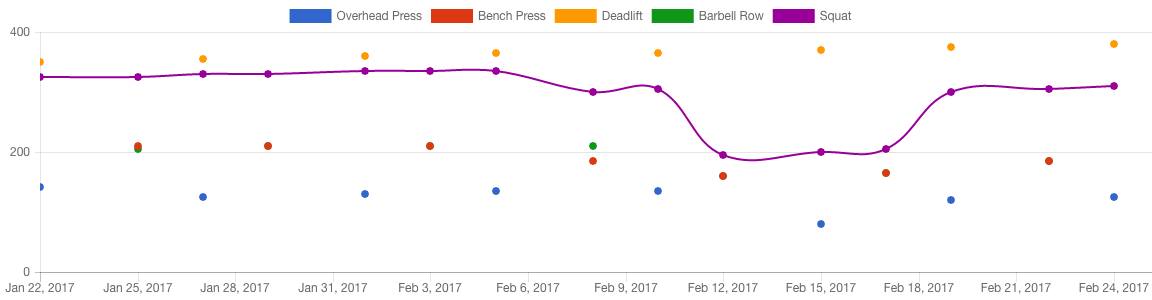
|——————+———–+——–+——+———| | Date | Body Weight | Bench Press (5x5) | Deadlift (1x5) | Squat (3x5) | |——————+———–+——–+——+———| | Sun, 22 Jan 2017 | 237.0 lb | | 350.0 lb | 325.0 lb | | Wed, 25 Jan 2017 | 239.0 lb | 210.0 lb | | 325.0 lb | | Fri, 27 Jan 2017 | 238.0 lb | | 355.0 lb | 330.0 lb | | Sun, 29 Jan 2017 | 235.0 lb | 210.0 lb | | 330.0 lb | | Wed, 01 Feb 2017 | 234.0 lb | | 360.0 lb | 335.0 lb | | Fri, 03 Feb 2017 | 235.0 lb | 210.0 lb | | 335.0 lb | | Sun, 05 Feb 2017 | 234.0 lb | | 365.0 lb | 335.0 lb | | Wed, 08 Feb 2017 | 234.0 lb | 185.0 lb | | 300.0 lb | | Fri, 10 Feb 2017 | 234.0 lb | | 365.0 lb | 305.0 lb | | Sun, 12 Feb 2017 | 236.0 lb | 160.0 lb | | 195.0 lb | | Wed, 15 Feb 2017 | 230.0 lb | | 370.0 lb | 200.0 lb | | Fri, 17 Feb 2017 | 231.0 lb | 165.0 lb | | 205.0 lb | | Sun, 19 Feb 2017 | 228.0 lb | | 375.0 lb | 300.0 lb | | Wed, 22 Feb 2017 | 231.0 lb | 185.0 lb | | 305.0 lb | | Fri, 24 Feb 2017 | 229.0 lb | | 380.0 lb | 310.0 lb | |——————+———–+——–+——+———|
The next step will be to perform another body composition test to see how much of the weight loss is from body fat vs lean mass. Given that I haven’t seen a significant drop in strength, I would expect to see most of the reduction come out of fat storage.